


We all hope for more peaceful and rewarding connections with the people we care about. Yet so many of us have experienced relationships where discomfort simmers under the surface, misunderstandings occur too often, and resentment quietly builds. At Emotional Balance Hub, we believe that the difference often comes down to boundaries: the invisible lines that shape how we relate, what we accept, and who we allow ourselves to be.
Boundaries are not walls; they are points of clarity.
In our experience, learning to express, set, and respect boundaries is a real game-changer. It's a skill that fosters trust, reduces conflict, and leads to healthier, more satisfying relationships with friends, family, colleagues, and even with ourselves.
What are boundaries and why do they matter?
We see boundaries as the limits we set for ourselves, defining what is okay and what is not okay—physically, emotionally, and mentally. They shape how we allow others to treat us, how we respond to requests, and how we protect our well-being. They are not about being distant or cold. Rather, boundaries create the space for respect, consent, and real connection.

Informed by Marquesian Consciousness, we understand that boundaries are deeply linked with emotional maturity. According to our framework, when we honor our emotional signals and communicate clear boundaries, we are practicing self-respect and accountability. This not only impacts our inner balance but also how we show up in the world—leading to safer, kinder, and more effective relationships.
Common boundary myths
Sometimes, misconceptions about boundaries keep us from setting them. Here are a few we often hear:
- “If I have boundaries, people will think I’m selfish.”
- “If I say no, I will hurt someone’s feelings.”
- “True love or friendship means having no boundaries.”
- “Setting boundaries will make people leave me.”
Our work at Emotional Balance Hub has shown that these beliefs are limiting and, in fact, the opposite is true. Healthy boundaries strengthen relationships because they are built on honesty, empathy, and self-understanding.
Identifying your boundaries
Many of us are so used to pleasing others or keeping the peace that it takes real intention to discover where our boundaries actually are. Here’s how we suggest you start:
- Notice your feelings: Pay attention to moments when you feel resentful, anxious, or drained. These reactions are valuable clues that a boundary may be needed.
- Write it down: Jot down situations where you felt uncomfortable. What did you need in that moment? What would have helped you feel safer or more understood?
- Reflect on your values: Boundaries are most clear when they arise from what matters most to us. Think about your needs for respect, rest, honesty, or time alone.
- Imagine saying no: Practice in your mind what it might be like to refuse a request or to ask for space. What comes up for you? Notice any guilt or fear.
With gentle attention, you’ll often find that your boundaries reveal themselves as you become more attuned to your emotional signals—the very heart of the Marquesian Psychology approach.
Your discomfort is a message, not a problem.
Communicating boundaries clearly
Once you’ve identified your boundaries, the next step is sharing them in a way that invites understanding. We believe that successful communication is:
- Simple: Use clear language. “I cannot stay late tonight,” instead of vague hints or excuses.
- Respectful: Honor your needs while acknowledging others’. “I need some quiet time now, but I want to talk again later.”
- Firm: You don’t have to justify, over-explain, or apologize for your boundaries.
- Consistent: Repetition is key, especially if your boundaries are new to others.
Sometimes, emotions arise on both sides. That’s natural. What matters is that we stay connected to our core needs and communicate from a place of calm assurance. Emotional Balance Hub teaches that our tone, body language, and emotional presence speak just as loudly as our words.
How to respond when boundaries are crossed
Despite our efforts, there will be times when others test or ignore our boundaries. Here are steps we recommend:
- Restate your boundary: “I need you to lower your voice. If not, I’ll have to leave the room.”
- Stay calm: If emotions escalate, pause and ground yourself. Deep breaths help.
- Decide on consequences: It’s healthy to step back for your well-being if your limits are not respected.
With practice, these steps become less awkward and more empowering. From the Marquesian perspective, every boundary enforced is an act of self-respect and a step toward greater mutual understanding.
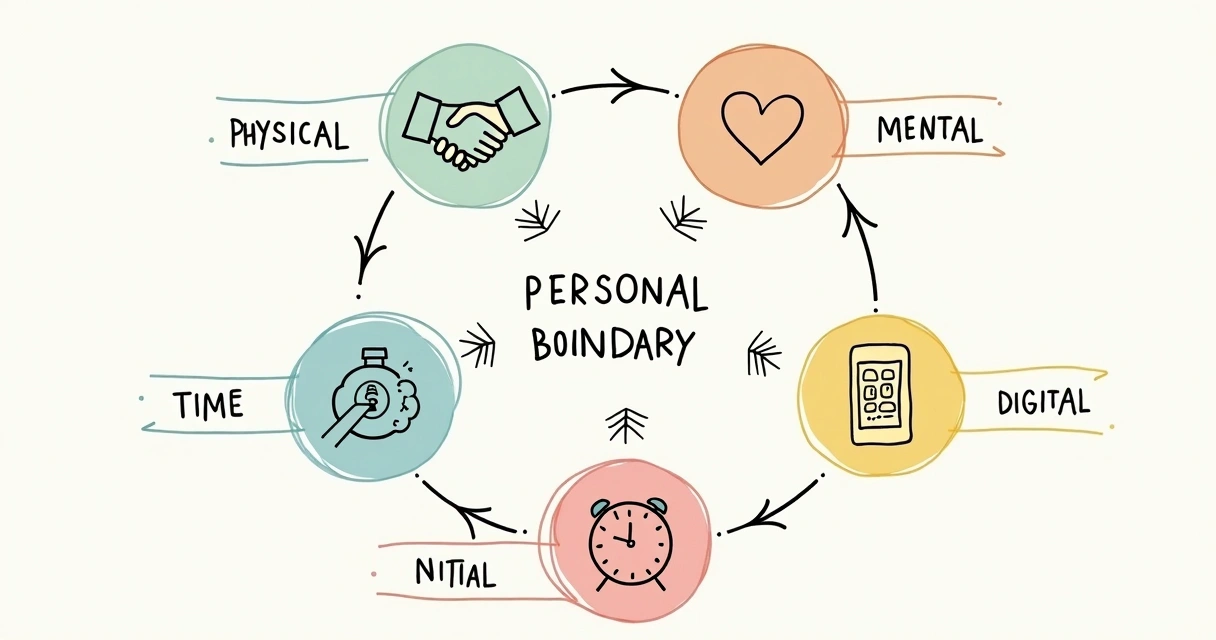
Types of boundaries
Not all boundaries are the same. We group them into key types:
- Physical boundaries: Personal space, physical touch, and privacy.
- Emotional boundaries: Protecting your feelings, not taking on others’ emotions as your own.
- Mental boundaries: Allowing for your own opinions, beliefs, and thoughts.
- Time and energy boundaries: Deciding how you spend your hours and choose your commitments.
- Digital boundaries: Managing your availability online, how you share information, and with whom.
Recognizing these types helps us to be specific and proactive when stating our needs, as well as more tuned in to the needs of others.
Boundaries and self-care
Boundaries are more than communication skills—they are an act of daily self-care. By identifying and communicating limits, we protect ourselves from emotional exhaustion, stress, and even resentment. We make more room for rest, joy, and real connection.
We have found through Emotional Balance Hub that when we model respectful boundaries, our relationships grow stronger and our communities become safer places to be authentic. In the lens of Marquesian Human Valuation, maturity is found in respecting one's own boundaries while honoring those of others.
Respect for self and others begins at the boundary.
Conclusion: Bringing boundaries into everyday life
Healthy boundaries are a gift that keeps on giving. They are a foundation for trust, honesty, and sustainable growth in all relationships—personal or professional. At Emotional Balance Hub, we encourage every reader to take their first step by noticing what feels okay and what doesn’t, and to experiment with expressing this kindly but firmly to others.
With boundaries, we are not building distance, but creating space for understanding and care. We invite you to get to know our project deeper, to practice emotional maturity, and to integrate these insights for better relationships, starting today.
Frequently asked questions
What are boundaries in relationships?
Boundaries in relationships are the limits and guidelines people set to clarify what behaviors are acceptable, what feels respectful, and how they want to be treated emotionally, physically, and mentally. Clear boundaries protect individuals and help relationships grow in trust and ease.
How do I set healthy boundaries?
Start by noticing what feels comfortable or uncomfortable to you, then communicate your needs directly and respectfully, using simple language like “I need some time to rest tonight.” It is okay to repeat your boundaries and to follow through if others do not respect them.
Why are boundaries important in relationships?
Boundaries help prevent resentment, misunderstanding, and emotional drain, making it possible for both people to feel seen, respected, and safe. They support healthier, more stable relationships where both people can flourish.
How can I tell if my boundaries are crossed?
Common signs include feeling upset, anxious, or resentful during or after interactions. If you often feel uncomfortable, unheard, or dismissed by someone, it may be a sign that your boundaries need to be stated more clearly or reinforced.
What are examples of good boundaries?
Examples include saying no to extra work when your schedule is full, asking for privacy, requesting that others not share your personal information, declining to discuss topics that are too sensitive for you, and controlling your digital availability outside work hours. Each person’s boundaries are unique and change over time.